
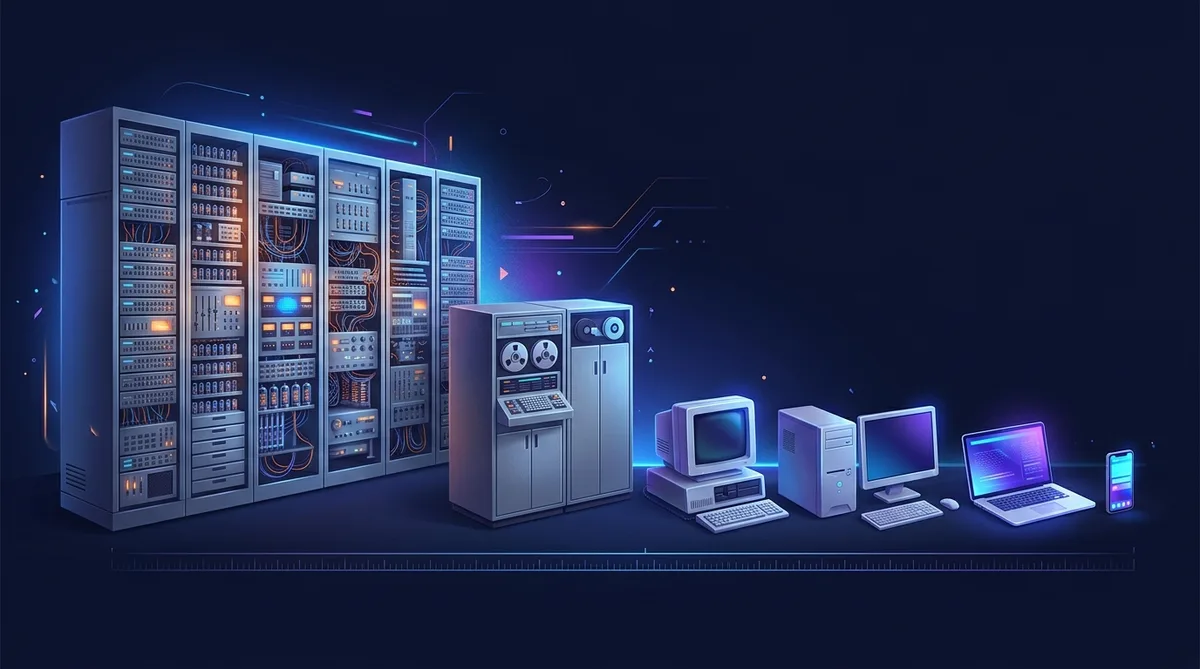
The evolution of computers: from 27-tonne ENIAC to your phone
In 1945, ENIAC filled a room, weighed about 27 tonnes and did 5,000 additions a second. The phone in your pocket weighs 171 grams and does billions of operations every second. This is how computers shrank — and why the biggest ones are growing again.
1940s–50s: machines the size of a room
The first electronic computers were built for war and science. Britain’s Colossus (1944) broke German codes at Bletchley Park. America’s ENIAC used 17,468 vacuum tubes along roughly 30 metres of panels, and UNIVAC I (1951) became the first computer sold to businesses in the United States.
1960s–70s: mainframes and the first supercomputer icon
Transistors and then integrated circuits shrank computers to the size of wardrobes. IBM’s System/360 (1964) became the standard business mainframe, and the Cray-1 (1976) — shaped like a C with a padded bench around it — was the fastest computer of its day at about 160 megaflops.
1977 onwards: computers come home
The Apple II (1977), the IBM PC (1981) and the original Macintosh (1984) put computers on desks. Laptops then folded them into bags, and smartphones into pockets.
Supercomputers: the new giants
At the top end, computers are growing again. Today’s fastest machines fill halls the size of two tennis courts with rows of liquid-cooled cabinets. Each year the TOP500 list ranks them:
The United States holds the top three spots; Germany’s JUPITER is Europe’s first exascale system; Japan’s Fugaku and China’s Sunway TaihuLight and Tianhe-2 were once number one; India’s PARAM Siddhi-AI leads its national programme. (China stopped submitting its newest machines to the list after 2021.)
Quantum computers: a different kind of machine
Quantum computers don’t just get faster — they compute differently, using qubits kept colder than outer space. IBM’s Quantum System One sits in a 2.7 m glass cube; the modular System Two is 6.7 m wide. They are still experimental, but they may one day crack problems no supercomputer can.
Compare ENIAC, a supercomputer and your phone to scale →